
Pulling up to a commercial rock yard for the first time is an incredibly intimidating experience. You are surrounded by massive front-end loaders, industrial scales the size of your truck, and giant mountains of crushed concrete and river rock. The operator at the counter is going to ask you exactly how much material you need, and if you just shrug and give them a rough guess, you are going to waste a massive amount of money.
Guessing means you either pay hundreds of dollars in heavy freight delivery fees just to run short and completely halt your weekend project, or you end up with a permanent, three-ton mountain of leftover gravel sitting right in the middle of your driveway.
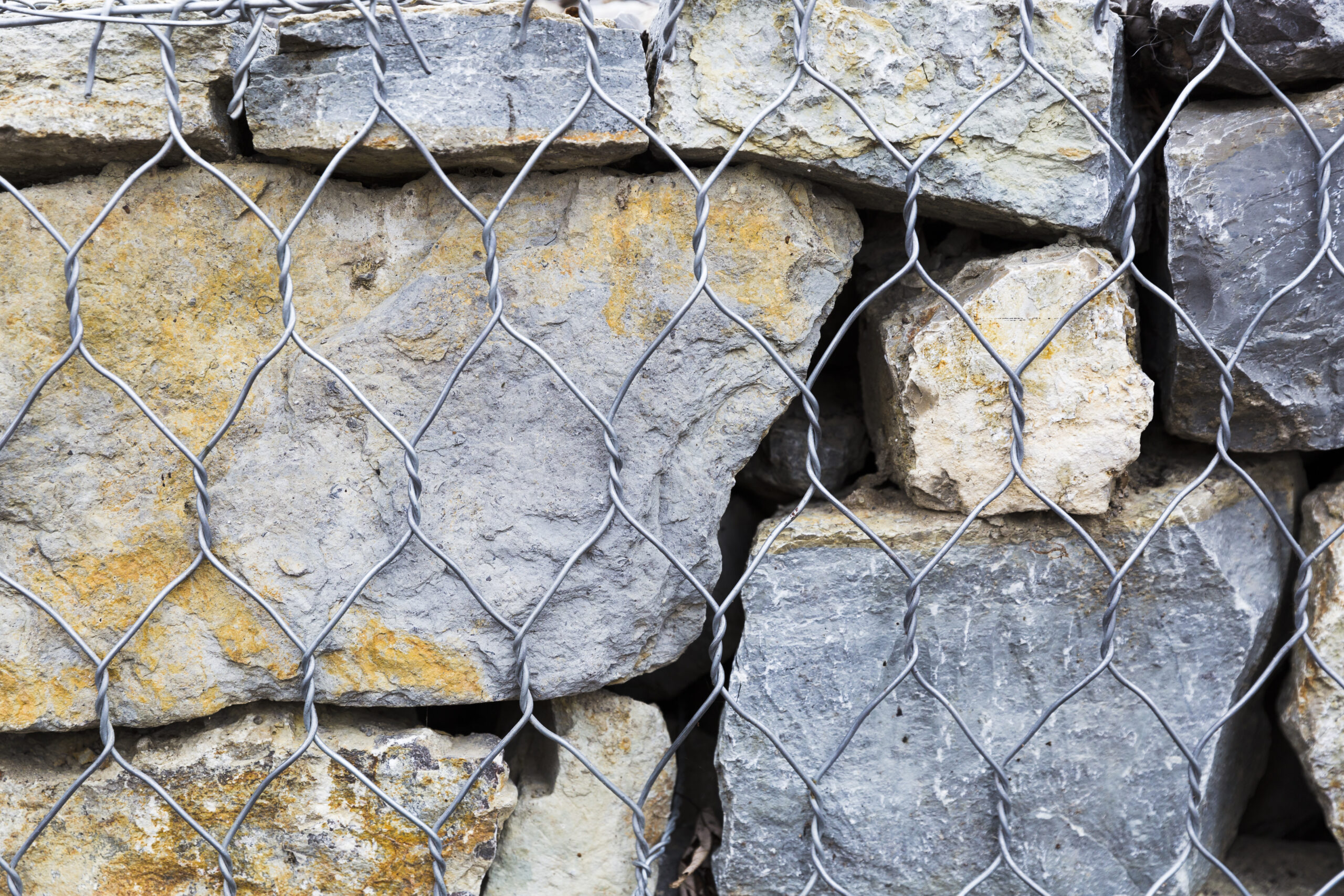
If you are building a retaining wall or a privacy fence using heavy-duty gabion baskets, you absolutely cannot rely on rough visual estimates. The heavy steel wire provides the rigid structure, but the dense rocks provide the actual earth-stopping mass. You need to understand basic volumetric math before you ever set foot on the commercial scale.
If you want to avoid multiple expensive delivery fees and finish your backyard project on time, here is exactly how to calculate the stone you need so you only buy what you actually use.
1. The Core Volumetric Formula
You do not need an advanced engineering degree to figure this out, but you do need a tape measure and a calculator. Every single hardscaping project starts by figuring out your total cubic feet.
You find this by measuring the interior of your wire baskets. You multiply the Length by the Width by the Height in feet. If you have a standard basket that is 3 feet long, 3 feet wide, and 3 feet tall, you have 27 cubic feet of empty space to fill.
However, rock yards do not sell material by the cubic foot. They sell material by the cubic yard. To convert your math, you simply take your total cubic feet and divide that number by 27. Conveniently, a standard 3x3x3 basket equals exactly one cubic yard of material. If you have a massive retaining wall made of twenty of these baskets, you know you immediately need twenty cubic yards of stone to fill the empty space.
2. The Weight Conversion Problem
Figuring out your cubic yards is only the first half of the battle. When you finally call the rock yard to place your order, you will quickly discover a frustrating industry standard: many quarries measure in volume but sell by the ton.
You have to convert your cubic yards into tons, and this requires understanding the density of the specific stone you are buying.
Different rocks have completely different densities. A cubic yard of porous lava rock weighs significantly less than a cubic yard of dense, solid granite. As a general industry baseline, one cubic yard of standard crushed concrete or heavy river rock weighs roughly 1.3 to 1.5 tons. If your backyard project requires ten cubic yards of space to fill, you need to order approximately fourteen tons of heavy stone to get the job done. Always ask the supplier for the specific weight-to-volume ratio of the exact rock pile you are buying before you finalize the invoice.
3. Understanding the Void Ratio
Rocks are not liquid. When you pour a bucket of water into a square container, the liquid fills every single microscopic corner. When you dump a load of angular rocks into a steel wire basket, they do not sit perfectly flush against each other, and this creates the void ratio.
Because rocks have irregular shapes, a significant portion of your basket will actually just be empty air trapped between the stones. Depending on the size of the rocks you choose, the void space inside your structure can be anywhere from 30 to 40 percent. This means you do not need to over-order your materials out of fear. The raw mathematical volume of the basket naturally builds in a massive buffer because the rocks will never pack down perfectly tight.
4. Matching the Rock Size to the Mesh
The absolute fastest way to ruin your project is to buy stone that is completely incompatible with your specific steel mesh.
If your wire panels have openings that are 3 inches by 3 inches wide, you cannot buy cheap, 2-inch driveway gravel. The second you dump that gravel into the top of the basket, it will immediately spill straight out the sides and all over your lawn.
You must buy stones that are physically larger than the holes in your wire mesh. For a standard 3-inch mesh, you need to order rocks graded at 4 to 8 inches in diameter. Angular stones, like crushed limestone or recycled concrete, are highly preferred over smooth river rock because the sharp, jagged edges lock tightly together, preventing the rocks from shifting and settling over time.
Buy the Right Amount of Rock
Building a structural retaining wall or an industrial privacy fence is exhausting, heavy labor. You do not want to make the job infinitely harder by completely messing up the logistics of the material delivery. Stop guessing at the volume and hoping for the best. Take ten minutes to map out the exact dimensions of your layout, calculate the total cubic yards, convert that math into tons, and verify the rock size against your specific steel mesh. When you respect the math upfront, you guarantee a smooth build and avoid paying for a delivery truck twice.